May 28, 2026
Geometry of Action
There are moments in intellectual history when a domain passes from intuition into formal structure.
Quantity became number.
Logic became Boolean algebra.
Communication became information theory.
Formalization disciplines imagination. It creates an abstract space in which we can reason before acting. It reveals constraints, invariants, and failure modes of whatever we're modeling. It lets us ask which structures can work, and which structures can't, and why.
We can design bridges, buildings, circuits, and communication systems because we have formal maps of matter, energy, logic, and information. Those maps let us ask whether a bridge will stand, under what load, and where it will fail. We do not need to discover every structural error by trial and error.
But with systems that shape human action, this is still largely what we do.
We design reputation systems, social media feeds, search engines, protocols, and governance processes that shape what people notice, trust, ignore, and do. We know how to scale the technical side of these systems, but we have no comparable structural language for understanding the human side: how they shape action, and what outcomes they tend to produce.
What if misinformation, scams, trust fragmentation, and bot amplification are not just moderation or policy problems, but structural consequences of the way these systems are designed? What if they follow naturally from the action-spaces these systems create?
This essay asks how we might begin modeling those action-spaces structurally.
In Map of Meaning I proposed a map that sees humans as agents navigating possibility. This essay pulls one thread from that map: action. It derives a minimal grammar and applies it to Chronicle, a protocol for costly public orientation and recursive accountability.
I. A Small Grammar of Action
Praxeology began with the axiom that humans act. Here we begin one layer lower: with the space of possibilities in which action becomes meaningful.
Let denote the possibility space: the set of trajectories through which the world could unfold.
Consider a subject standing near the edge of a cliff. One trajectory leads to safety. Another leads to a fall.
Subjects do not inhabit these trajectories whole. They are local interfaces into . They experience the present as a field of possibility shaped by the probability of each branch. If the probability of falling is high, the field feels dangerous. If it is low, the field feels safe.
Let the subject's possibility field be , given by a probability distribution over the .
Trajectories are not neutral. We intuitively know that safety is better than falling, but to model action this ordering must be made explicit.
In Map of Meaning I defined Quality as the ordering of better and worse. Let denote the Quality of a trajectory . In our case:
These numbers aren't measurements. They are coordinates for an ordering. They let us say formally that one trajectory is better than another.
The local Quality of a subject's field is the probability-weighted Quality of its possible trajectories:
If the probability of falling is 10% then:
If the subject steps back and reduces the probability of falling to zero, the field improves. Its local Quality rises from -10 to 0.
The change in local Quality of two fields is Value.
When a field is transformed by an action , we can write the Value induced by that action as:
Action is therefore a transformation of the possibility field:
The subject’s action space is the set of transformations available in the present field.
In the cliff example, shifts probability mass toward , shifts it toward , and preserves the current distribution.
Standing still may leave the objective world unchanged, but it preserves danger that could have been reduced by stepping away.
An action can be evaluated only against the background of what could have been done but was not.
Let be the set of attainable fields excluded by choosing action .
This is the other side of action: to choose one transformation is to exclude the others.
A subject who chooses to stand still near the cliff excludes the safer alternative that stepping back would have created. In objective space, nothing happened. In possibility space, something was lost.
Actions operate primarily within possibility space, not objective space.
This aligns with how praxeology defined action: what a subject does in pursuit of a preferred state. Action may appear as outward movement, but movement does not define it.
Finally, to reason about sociotechnical systems, we need a simple way to summarize whether a field invites action or warns against it.
Trust is one such summary. Any possibility field carries a distribution of anticipated Value outcomes. Trust describes whether that field leans positive or negative:
Trust answers a practical question: if I enter this field, does the future tend to improve or degrade?
This gives us a minimal grammar:
- possibility space ,
- field ,
- Quality ,
- field Quality ,
- Value ,
- action ,
- action space ,
- excluded alternatives ,
- trust.
This grammar gives us enough to ask a design question: can a system reshape possibility so that useful action compounds into future influence, while harmful action degrades it?
II. The Signal Layer
The internet has many signals, but few real ones.
By real signal I mean one grounded in sacrifice. To signal that something matters, one must give up some alternative. But online, accounts are cheap, opinions are free, links are cheap, reviews are cheap, and identities are disposable. Almost nothing has to be given up.
This is the structural vulnerability at the heart of the internet. Noise, scams, misinformation, and trust fragmentation arise from this asymmetry.
In Compass for the Good, I argued that a public signal of Quality can emerge from costly orientation. Chronicle is an attempt to implement that primitive.
Chronicle works in two ways:
- It attaches cost to orientation
- It makes actors recursively accountable for orientation
Both can be understood in terms of Google's PageRank algorithm, which found signal in the structure of the web.
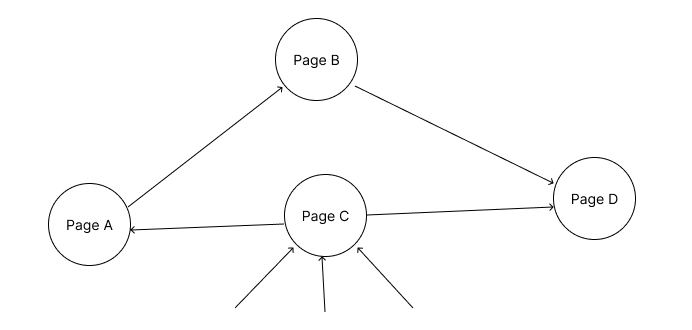
First, a link from one page to another is a small act of orientation: a human judgment that the destination matters. The more links point toward a website, the more valued or important it appears.
Second, a link from an important page matters more than a link from an obscure page, and importance itself is derived from the structure of incoming links. Therefore, importance flows recursively through the graph.
In a graph like this, Page D receives importance from both Page B and Page C.
First, a link is replaced by a published event that sacrifices some monetary value. For example Bob's orientation against shop.scam with -10000 msats:
["web:domain", "shop.scam", -10000, "bob_pubkey", 1731088810123, "bob_sig"]
The event specifies the kind of subject, the subject itself, the signed amount, the actor’s public key, a timestamp, and a signature. It is not an opinion, but a public action with measurable cost.
Second, orientations from credible actors can be given more weight than orientations from low-reputation actors, and credibility itself is derived recursively from how others have oriented toward those actors and their past events. Therefore, credibility flows recursively through the graph..
In the graph below, Bob orients against shop.scam, Alice orients toward his event, and Dave orients toward Alice's public key. Dave’s credibility increases the weight of Alice’s judgment, which increases the credibility of Bob’s warning.
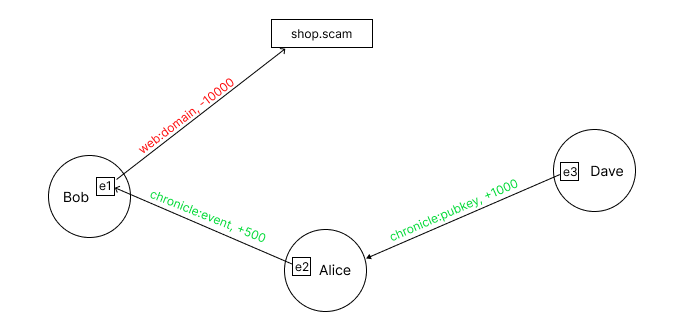
The web’s link structure was implicit, ambiguous, and cheap to manipulate. A link could mean endorsement, criticism, citation, humor, or spam. Chronicle makes orientation explicit: toward or away, with magnitude, signature, and accountability. Any canonical subject can become a node in the graph: a domain, an email address, a phone number, a message, a prior event, or an actor.
Chronicle standardizes the graph. Clients compute reputation and trust from it. Browsers, email clients, forums, search engines, review systems, and social platforms could use it to warn before opening a dangerous domain, suppress messages from low-reputation senders, or surface comments from actors with stronger reputation.
Chronicle is useful as a case study because its primitive action is costly and measurable. Monetary sacrifice gives up economic possibility. Reputation, which emerges from these acts over time, becomes social possibility: it governs reach, weight, and accessibility in Chronicle-aware systems. Because money and reputation can serve as measurable proxies for local field Quality, we can study the consequences of orientation as transformations of possibility fields.
A Chronicle event can shift the possibility field by changing what a user is likely to trust, open, read, answer, or avoid. A good warning can move probability away from a worse future. A malicious endorsement can move probability toward one. Either way, orientation becomes action: it transforms the possibility field.
III. Structural Integrity
We can now use this grammar to examine one local loop in Chronicle.
Our question is whether a useful act of orientation can improve someone’s possibility field, then compound into future influence for the actor who made it.
Suppose shop.scam is malicious and Alice may encounter it. The possibility space is simple:
Let Quality values for the two trajectories be:
Alice has a baseline 10% chance of entering the scam branch:
Her initial field Quality is therefore:
Now suppose Alice uses a Chronicle-aware browser. The browser computes a client-specific trust score for a domain from the Chronicle graph.
For this toy model, let trust in a domain be a reputation-weighted sum of orientations:
where is actor reputation, is the actor’s orientation toward subject , and is the credibility-weighted orientation required for full confidence.
Assume .
At first, the graph contains only a weak positive orientation toward shop.scam: an actor with reputation orients toward it with .
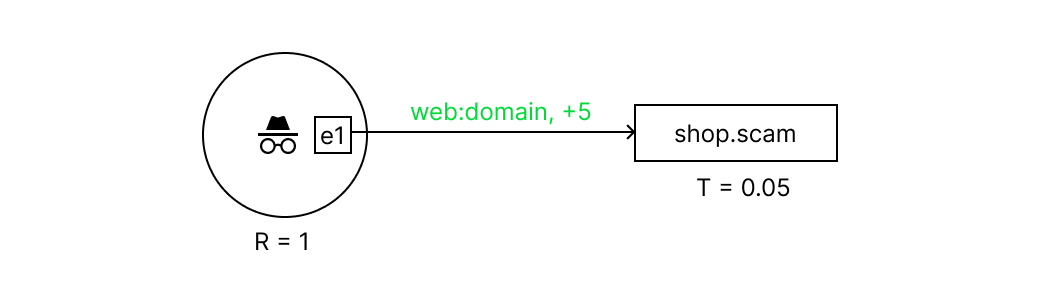
In this toy model, positive trust adds no warning friction, while negative trust reduces the probability of Alice entering the scam branch:
where .
Since , Alice receives no warning. Her scam probability remains , and her field Quality remains .
Now suppose Bob knows the site is dangerous. His action space contains two simple options:
The first action transforms Alice’s field by adding a negative orientation to the Chronicle graph. The second preserves the current field.
Bob has reputation . If he chooses , he publishes a negative orientation :
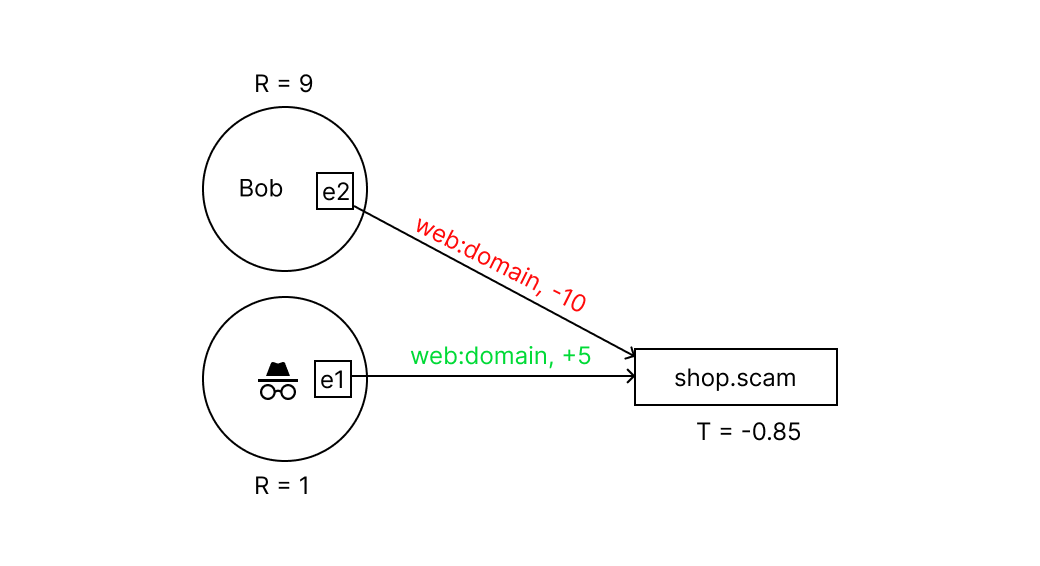
Alice's scam branch probability falls:
Her new field Quality is:
Bob’s warning has transformed Alice’s field. The Value of that action is:
In this local model, Bob’s warning creates units of Value for Alice by shifting probability away from the scam branch and toward the safe branch.
If Bob chooses instead, the improved field created by warning is excluded:
In objective space, Bob’s silence may look like nothing. In possibility space, the safer field Alice could have entered is left unrealized. For one Alice, the excluded Value is . For similarly exposed users, the potential social Value of warning scales roughly as .
Chronicle matters because Bob’s warning does not disappear after helping Alice. Others can orient positively toward Bob’s warning if it proves useful, or toward Bob’s public key if he proves reliable over time. His future warnings can then carry more weight.
This is the positive loop: useful action compounds into future influence.
The negative loop works in reverse. If an actor endorses a scam, others can orient negatively toward that endorsement or toward the actor. Harmful action can degrade reputation, reducing future influence.
This gives us a first definition of structural integrity for a sociotechnical system:
A system has structural integrity when useful action tends to compound into future influence, while harmful action tends to consume influence faster than it can profitably exploit it.
IV. What This Suggests
This toy model does not prove that Chronicle has structural integrity. It examines one local loop: how a warning can shift Alice away from a harmful trajectory, and how the usefulness of that warning can feed back into Bob’s future influence.
It leaves out almost everything else.
It does not model Bob’s side: how sacrificing money changes Bob’s own possibility field, how reputation alters his future reach, or how the tradeoff between monetary cost and reputational gain should be measured.
If money and reputation are proxies for local field Quality, then Bob’s warning has two sides. It improves Alice’s field by reducing danger. It alters Bob’s field by consuming money while potentially increasing credibility.
A more complete model would have to account for this.
Under what conditions does the gain from scamming exceed the cost of misleading orientation and future reputation loss? How should a client scale its trust threshold to the risk of the action, so that reading a page, buying a product, and wiring money require different levels of credibility? How much influence can be bought with money, and how much must be earned through credible inflow from the wider graph?
Without a formal language, these questions remain vague. With one, they become statements about how action, trust, cost, and influence reshape the field.
This was the premise of the essay. Formal language lets us reason about structure before acting. We can design bridges before building them because we have formal maps of matter. If we wish to design systems that shape action well, then we need formal maps of action too.
The grammar here is minimal, but it suggests that action can be studied structurally.
For now, the most immediate use of this grammar is modeling Chronicle so we can understand the consequences of its design. As that modeling matures, the same techniques may become useful for designing other sociotechnical systems: feeds, reputation systems, search engines, review platforms, governance processes, and protocols.
If action has a geometry, then the disorder around us may not be inevitable. Scams, misinformation, and trust fragmentation may be symptoms of systems built without a map.
As the map improves, better systems become easier to imagine, test, and design.
For more context, the Chronicle whitepaper explains the idea, the GitHub protocol specification gives the builder-facing details, and my working notes collect the broader mathematical framework behind this essay. If any of this seems like territory you would want to help stress-test, build, or map, I’d love to hear from you.