Evaluation
Evaluation of a state is the perception of its worth or Value relative to the frame of reference.
Different subjects have different Quality judgements and different initial states given by their unique frame of reference. Therefore, it is natural that they might evaluate the same state differently.
The subject's Quality judgement is given by , and their evaluation by .
The ultimate Quality (and by extension Value $V = ∆Q$) is always the same for everyone, but they are perceived differently based on who's looking at it. That is because subjects see only a limited slice of reality given by their narrow frame of reference. There are better perceptions and worse judgements of Quality—ones that are more aligned with the Ultimate and ones that are less aligned with the ultimate Quality. Therefore there are better and worse evaluations.
The following graph shows the divergence of subjective evaluations from the ultimate (or actual) evaluation:
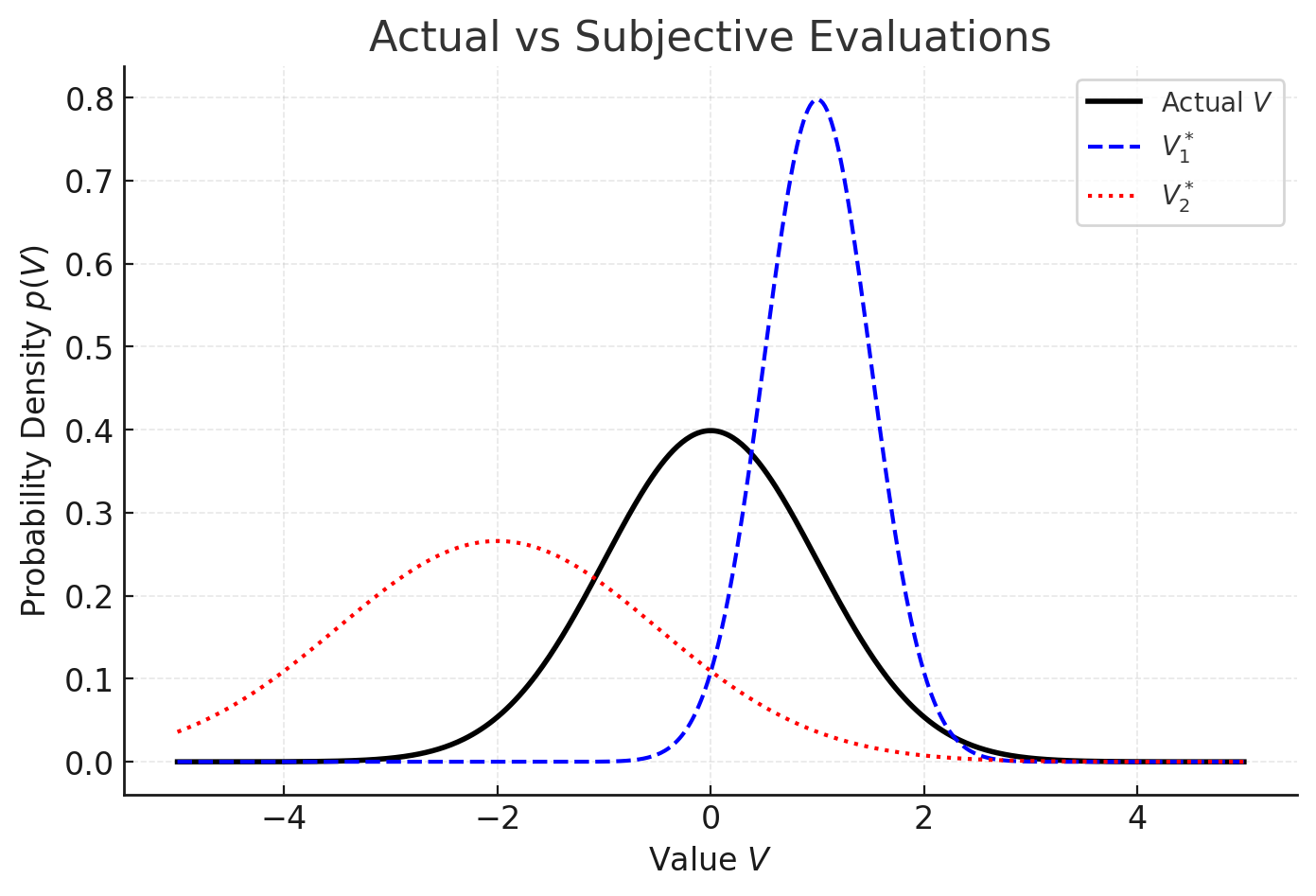
Different subjective evaluations lead to different actions. The first subject is more likely to select this frame, because he feels positive about it, while the second is more likely to ignore it, because he feels negative about it. Feeling is the means by which the process of subjective evaluation happens. In Carl Jung's taxonomy of four cognitive functions (thinking, feeling, sensing, intuition), feeling is the perception of Value.
When imagining and evaluating some scenario or frame, subjects perceive an emotional "landscape", a feeling that corresponds to the shape of the distribution (see Potential). Positive feelings will correspond to positive evaluations, negative feelings to negative evaluations. More differentiated feeling categories like anxiety, hopelessness, optimism can be described by a specific shape of the probability density function of Value. A distribution with equal density of good and bad outcomes could map to a form of anxiety, with different probabilities and magnitudes of Value representing different colors and shades of anxiety.
The degree to which the feeling is "right" or true is the degree of alignment of subjective evaluation with the ultimate evaluation. The subject that is more aligned with Truth will overall take better actions than the subject that is less aligned with Truth.